Tuesday, May 5, 2009
My new blog
Have just initiated a new, more specialized blog on wordpress called CompanyBrands. This one will strive to be more professional, serious content oriented and will bring together content around the idea of company branding in one place.


Friday, March 27, 2009
Twitter vs. Facebook

Am getting sucked into it kicking and screaming, but just can't avoid trying these guys out...afterall being in touch with the latest is one thing our clients expect out of us...
Here is a wonderful interview with Chris Brogan that explains a whole lot about how the world of blogging/facebook/twitter etc. works.
Particularly like this bit below drawing the differences between facebook and twitter---
Twitter is much more lightweight than Facebook. The barrier to entry is so much smaller. You can use a cell phone to do it. You can use a desktop computer. You can use any Web browser in the world. There are multiple ways to get a conversation going. So that's the first point, that it's very easy for the masses to make messages go back and forth.
It's restrictive in the same way that a haiku or a sonnet is restrictive and makes interesting poetry. Twitter's restriction is that you're allowed 140 characters or less to answer the question, "What are you doing?" I tell people to re-write that question to, "What has your attention?" because that answer is almost always more interesting. Twitter is just a faster one-to-many platform. Biz Stone, one of its founders, often calls it a multi-modal messaging platform. It allows you to talk back and forth with "friends" or you can read what they have to say and just stalk.
Facebook is a lot richer in its interaction opportunities. There are games, videos, small message spaces called walls, and an internal email system. Facebook allows you to express a lot more personality and have more presence. You can join groups in Facebook.
Saturday, November 29, 2008
A home for your hobbies

A well executed service concept can be a great inspiration and Pidilite Hobby Ideas is one such. Recently walked into one their outlets (Bangalore) and besides the amazing range of goodies that Pidilite has put together from across the world, one is struck by the overall service experience.
Hobby ideas is an upstream stationery shop which caters to a host of pastime pursuits – from the regular like painting, sketching etc. to more exotic ones like clay modelling, wood modelling etc. Besides it has accessories that enable even novices like me to produce something which is aesthetically acceptable. There are dye-cuts, punches, glitters, origami papers, and all sorts of things which can take even a simple greeting card to a new level of accomplishment.
It is all put together with enormous care and attention and the excitement one feels is similar to the one in a toyshop for a child!
Moreover, what really caught my imagination is the way they are going about marketing themselves. One can attend a free workshop every evening for 3 hours with a highly skilled Pidilite person and produce a hobby idea (which are all displayed in the store), and they also have a service where one can organize a birthday in a part of the store with a customized workshop where the stuff that the guests produce can be taken home as the return gift. In December they are launching a series of weekly workshops aimed at homemakers and children.
It is this kind of experiential marketing that creates a high degree of loyalty in customers. Pidilite have not gone for a high profile media blitz or an invitation sale, instead they have opted for a more difficult, slow burn path to create a small but dedicated base of customers who have experienced the joy of producing a hobby.
And we all know that it is not so easy for a highly product oriented company to pull something like this off in the service domain.
Have always admired this little gem of a company out of Mumbai for its innovative ways but we will leave that for another post.
Sunday, November 16, 2008
Bharti’s New Identity


Because this blog’s central focus is on brand building for ‘organization brands’, every time a significant corporate brand undergoes a facelift, I am tempted to add my two bits.
The Bharti Group being the latest one to go in for a new garb.
Frankly, more often than not I have felt that the visual identity changes tend to be taken up without any real change on the ground. In fact, one gets the sense that it is often to create a sense of activity in the absence of any real change on the ground.
However, in the case of Bharti, clearly the organization had transformed way beyond what its earlier identity reminded stakeholders of. There was a clearly a case of underlining that change and getting all the diversified forays of the group underlined in public memory. Having built a hugely successful core business in telephony, the group has also attracted the likes of Wal Mart and Axa to partner with it.
The new logo makes no attempt to maintain continuity with the past, indicative if the trajectory the group’s growth has followed. It is a striking new font in a color that one doesn’t see very often and the subtle idea in the perpendicular arrow-heads is well integrated into the unit.
Having said that, one also wonders whether the group missed out on an opportunity to make the idea work a little harder.
Fundamentally, the new identity, with all its attempts at taking the high ground, fails to capture the uniqueness of the Bharti personality. Part of the reason being the lack of idiosyncrasy in the Bharti group itself. They try very hard to portray a good, responsible big boy image and model themselves on the Sri Rama Archetype much like TATA or Infosys does.
Even the advertising around the new idea is as motherhood as one can get with the core message of ‘small steps resulting in something big’ and using metaphors like Gandhi etc. is nothing but a lazy attempt at creativity, with neither much upside nor much downside (when Apple did 'the crazy ones' more than a decade ago it was an idea and they could pull it off, but subsequently many have tried to ride on it without it really sticking to them). The full page ad Bharti did about a week back, could have belonged to a dozen other success stories of the last decade.
The TV commercial looks more like an a/v one would do for an internal sales meet to kick it off on a high.
Instead a closer to reality story probably would have worked much better.
There is a certain endearing humility to Mr. Sunil Mittal, which is a quality the group may do well to capture. Also, it has more Indian-ness than an Infy or a TATA, reflected in its North Indian roots and its ‘band of brothers’ management structure. In a way this makes the group more earthy, accessible and charming. They seem to be in denial of their rough edges and in the process miss out on the spunk.
It is a Dhoni compared to the Dravid/Kumbles, that it tries to walk in the footsteps of.
This cultural uniqueness of this group, along with its stellar business success could have given the communication that edge that it currently sorely lacks.
Sunday, September 21, 2008
Jaagore Ideas!


Have been privileged to be associated with TATA Tea's initiative onebillionvoters in collaboration with Janaagraha. A simple idea of getting youth to register as voters. The idea is simple and backed by two inspiring parent brands...looks like a winner from the start.
But to me the bigger story is the team behind it. A bunch of youngsters, all in their 20s, most of them from an IIT/IIM pedigree have takes off from their well paying careers and within a span of a few months put together an exceptional backend to make this happen.
From a marketing perspective, it is a commendable effort by TATA Tea to introduce substance into the jaagore idea and give it a bite.
Very TATA if you care for my opinion. It is this brand's ability to walk more than talk on this front that makes it such an icon among brands.
There has been similar opportunity available for other brands as well. Of the current lot Idea cellular could do well to take its thought of eradicating illiteracy through mobile phones forward. I would have liked if Perter Emgland also could have taken the 'Honest Shirt' idea into a more action oriented territory to keep it fresh.
Saturday, August 16, 2008
Kudos for KILB

AEGON-Religare's KILB campaign is a wonderful usurping of a generic benefit of insurance i.e. risk protection, that has been lying unclaimed for many years now. I was fortunate to do a little bit of work almost 6 years ago on the category and at that time only Max New York Life was talking this language. I still remember the first question their advisor asked me- If you die today, how much money does your family need to survive. All others kept asking- What is your budget for premium payment?
India, thanks to LIC, has historically looked at insurance as an investment tool rather than a risk protection one. And as the MNYL advisor mentioned very vividly during my meeting 6 years ago- Sir, selling insurance as risk protection in India is a bit like whitewater rafting- it is very exciting but you are also going against the tide?
Hopefully KILB will do the job of reorienting the whole sector towards its core value proposition.
DNA of a Newspaper Launch
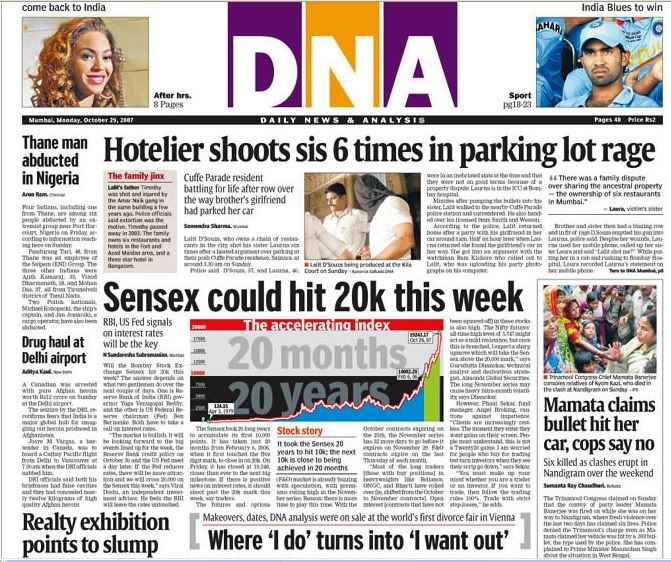
Off late Bangalore has been plastered with gigantic hoardings announcing the arrival of DNA, the newspaper initiative of the ZEE-Bhaskar combine. The campaign, which had an elaborate teaser phase, is now carrying ads which are supposedly insider’s take on what makes Bangalore a place to be proud of. There are references to cult eateries like Koshy’s, lots of software lingo etc. to mention a few. As someone who considers oneself to be a bit of a media-vore, the campaign, although eye catching, leaves me cold. The primary reason being that as an insider in the advertising/media fraternity, it is so templatized a launch, that one can see right through the kind of conventional thinking that has gone into it. In today’s times one is so inundated with exciting creative stuff all the time, particularly on the net, that this piece of work is just too passé. I can recall at least 5 such city launches of big brands across media and telecom space which have tried this hackneyed approach of trying to connect to a city’s culture.
Douglas Holt, whose book How Brand Become Icons, talks about brands that become a part of the cultural landscape and to me that is what a media brand strives for in the long run. He distinguishes three kinds of audiences- the insiders, who may not consume the brand but their nod of approval is necessary for a brand to get accepted, the followers, those who form the core consumption base of the brand and the feeders- who just emulate the opinion leading followers.
For DNA in Bangalore, the insiders are people in the media, advertising, journalism, theatre space i.e. the kind of crowd that populates a place like Koshy’s. While they may not buy DNA as they source their information and opinions from the net and the blogosphere, they feeling acknowledged and understood is critical for a Bangalore brand to be treated as an insider. To me this campaign, with its superficial understanding of the city, just doesn’t cut it with this audience.
Ideally this campaign should have focused on the core anxiety of the Bangalorean which is around the loss of innocence of the city in the pursuit of modernity and material prosperity. If DNA has presented an understanding of how Bangalore can make a role model for a dramatic reconciliation of the value of Openness, while simultaneously maintaining rock solid rootedness in some timeless values, my hunch is that DNA could have shown an understanding of the DNA of this city.
Sunday, August 3, 2008
Positioning India

Have been a big fan of Sunil Khilnani's The Idea of India and frankly, haven't come across a piece of writing that packs so much punch in as few as 200 pages. The book tries to get to the roots of how the Indian identity got created and deeply established in less than a century. If, about a hundred years ago one had asked any one living on the subcontinent who they were, no one probably would have played back 'being Indian' as one of the descriptors. Moreover, in the absence of a clearly defined geographical entity it was something that first needed articulation as there was no common Idea of India that everyone could relate to. The book explores how the Indian leadership, which was seeking freedom, had to first explore and articulate what the concept of India was. Nehru, Gandhi, Tagore, Savarkar etc. went in their own personal quests from various perspectives and eventually Nehru's vision prevailed over others and he even got the opportunity to orchestrate the post-independence India's initiatives to internally infuse the Indian identity on its citizens as well as position India on the global landscape.
Where Tagore reworked the poetic language and Gandhi turned to religious traditions to make their Indian selves, Nehru discovered India through the medium of history. temperamentally he saw the world historically; a perspective that at once defined his sense of political possibility and made him vigilant about attending to how the future would look back on his own actions.
As a student of Organization Brands, this book particularly interests me as a parallel for positioning a complex entity (like a Corporation)in a competitive scenario. In this case it happens to be even more challenging as the entity is marginal in terms of resources, is extremely heterogeneous and complex and exists more as a spirit rather than a well-defined geographical space.
Here is an excerpt from the book which captures the external challenge Nehru had to deal with--
Indianness was constituted out of internal diversity, but in Nehru's vision it was equally an international identity, a way of being in the wider world. In contrast to the sometimes narrowly domestic horizons of most in the nationalist movement, Nehru understood independence as an opportunity to establish India as a presence on the world stage. The international profile of states depended on their economic and military prowess, and India obviously could not make its mark in these domains. A new state like India, weak by international standards, would have to pursue its interests by creating its own opportunities and chances. By speaking the language of morality and justice, it might just be able to surprise and unbalance the more powerful, extracting concessions from their sheer embarrassment. Nehru, in this the follower of Gandhi, turned around the language of victim hood: instead of portraying India as a martyr to colonial subjection which had to turn inwards to find and repair itself, he affirmed India's character as a self confident actor in international politics.
MAD AND DEVINE by SUDHIR KAKAR

Just picked up Dr. Kakar’s latest titled Mad and Devine-Spirit and Psyche in the Modern World and am riveted by it. The book looks at the interplay between the spirit and the psyche and aims at distinguishing between the psychic and the spiritual phenomena. Besides insightfully articulating something as abstract as that, his brilliance lies in the ability to infuse poetry into the subject matter. I have been a keen student and follower of Dr. Kakar’s work and it is great to see him get back to non-fiction after a series of novels in the last 10 years. Although last year he came out with The Indians-Portrait of a People, but it was more a synopsized version of his earlier works. Check M&D out for a breathtaking journey into the inner theatre of the mind!
Subscribe to:
Posts (Atom)


 Posts
Posts


